


If you are starting a new airport job, you may need a medical test before you start work. An Airside medical UK assessment may also be required when moving into an airside role. The assessment checks whether you are fit to carry out your duties safely.
No single medical examination applies to every airport worker in the UK. Requirements can vary between employers and airports. They may also depend on your job duties and the employer’s occupational health policy. Some aviation roles also have specific regulatory medical standards. For example, UK CAA rules impose specific medical requirements on cabin crew.
This 2026 guide explains what to expect during an airside medical, how to prepare, and what to bring.
What Is an Airside Medical?
An airside medical is a health check for airport and aviation workers. It helps assess whether you are fit to carry out your specific duties safely.
The assessment forms part of occupational health in many workplaces. HSE guidance explains that occupational health looks at two things. First, how work can affect your health. Second, how your health may affect your ability to do your job safely.
An airport worker’s medical focuses on the demands of their job. It is not simply a general health check.
Who May Need an Airside Medical?

Not every airport employee needs the same assessment.
An Airside medical examination may be required if your job involves working in airport areas. This can include working around aircraft, airport vehicles, or equipment. It may also apply to other roles where safety is important.
It depends on the airport and employer; this can include roles such as:
- Ground operations, engineering, and maintenance workers.
- Catering or cleaning staff working airside.
- Airport security personnel.
- Certain aviation and operational roles.
Cabin crew is different because they have specific UK CAA medical requirements. All new cabin crew must have an initial medical examination. They must then have regular medical assessments. These assessments take place at intervals of no more than 60 months.
This distinction is important. Your employer may ask for a specific aviation medical examination or cabin crew medical report. They may also require another type of regulated assessment. Check the exact requirement before booking your medical.
What Happens During an Airside Medical?
1. Medical history
The evaluation process normally begins with a series of questions concerning your medical history. Yoons staff.
- Aircraft handling and turnaround staff.
- Baggage and ramp workers.
- Airside drivers.
u may also be asked to state any previous illnesses, surgeries, or injuries. You may also be asked about any current conditions. Be truthful and upfront about your medical condition.
2. Current health and medication
You may be asked to give information about medicines that you are taking. The clinician may decide whether your medical needs or treatment may have an impact on your ability to perform certain tasks safely. If you have questions or concerns regarding your prescriptions or job, consult a medical professional.
3. Vision
Vision may be part of your assessment. You may be asked if you wear glasses or contact lenses. It depends on your occupation whether you will also be asked to take a vision test.
Visual requirements can vary between jobs. Your employer or relevant occupational standard should confirm what applies to your role.
4. Hearing
Hearing may also be checked during the medical. This is particularly important for professions that involve communication, alarms, or machines.
Some workplaces in airports can be loud. The importance of good hearing will depend on your job and working environment.
5. Blood pressure and general checks
Blood pressure and other basic observations may be checked as part of the assessment.
The clinician may also carry out a general physical examination. This depends on the referral and occupational health requirements.
Further testing may be advised based on your medical history, test results, or job needs.
What Are the Airside Medical Requirements in the UK?
There is no universal set of airside medical requirements covering every airport worker in the UK.
This is one of the most important points to understand before booking.
Your requirements may be determined by a combination of:
- Your job description
- Your employer
- The airport
- Occupational health policy
- Workplace risk assessments
- Safety-critical duties
- Any relevant industry standards
- Specific aviation regulations, where applicable
HSE guidance states that employers must ensure workers are medically fit for their roles. Employers should also seek occupational health advice where appropriate.
If your employer has given you a medical form, job specification or referral letter, take it with you. It can help the clinician understand exactly what assessment is required.
How to Prepare for an Airside Medical?
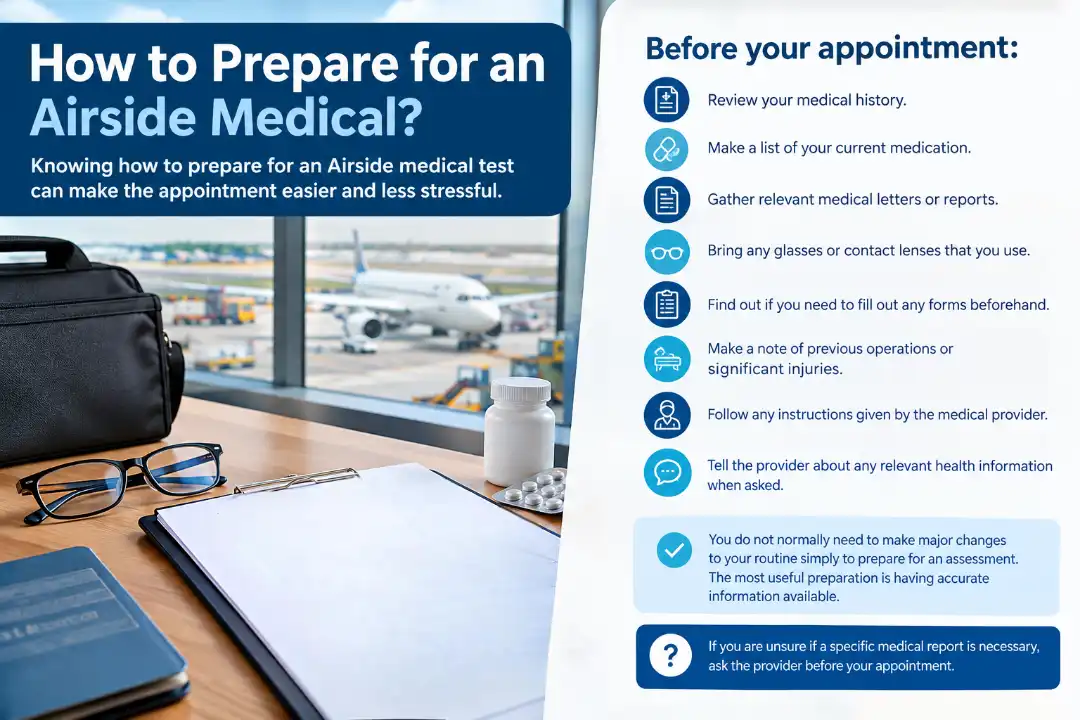
Knowing how to prepare for an Airside medical test can make the appointment easier and less stressful.
The first thing you should do is look over any instructions provided by your employer and see if they have provided a form, questionnaire, or list of requirements.
Before your appointment:
- Review your medical history.
- Make a list of your current medication.
- Gather relevant medical letters or reports.
- Bring any glasses or contact lenses that you use.
- Find out if you need to fill out any forms beforehand.
- Make a note of previous operations or significant injuries.
- Follow any instructions given by the medical provider.
- Tell the provider about any relevant health information when asked.
You do not normally need to make major changes to your routine simply to prepare for an assessment. The most useful preparation is having accurate information available.
If you are unsure if a specific medical report is necessary, ask the provider before your appointment.
What Should I Bring to a Medical Appointment?
A simple checklist can help:
Bring:
- Photo identification, if requested
- Employer or occupational health referral
- Any medical forms supplied by your employer
- Current medication details
- Relevant medical reports
- Glasses or contact lenses
- Details of your GP or other healthcare professional if requested
- Information about previous relevant conditions, injuries or operations
The exact list can vary between providers and employers.
If the medical is being done for a particular airport job, make sure that the provider knows what post you will be filling. The professional must know the occupational context if they are to properly evaluate the worker.
Why Do Employers Require a Medical for Airport Staff?

Airports involve aircraft, vehicles, equipment, restricted areas, and shift work. These can create different workplace risks.
Employers conduct occupational health assessments of employees to determine if there is a risk to their health and safety at work. An occupational health assessment may also identify the need for monitoring, support or reasonable adjustments.
The aim is not to exclude people with health conditions. Instead, it looks at how a person’s health, treatment or restrictions may affect their specific role.
Occupational health professionals also keep medical information confidential. Employers receive only the information they need to support fitness for work, subject to appropriate consent.
Can I Fail a Medical?
An Airside medical examination does not always have a simple pass-or-fail result.
The outcome depends on the assessment and the requirements of the job. A medical condition does not automatically prevent you from working at an airport. The clinician will consider your condition, treatment, job duties, and relevant occupational standards.
The outcome may confirm that you meet the requirements, request further information, recommend restrictions, or find that you are not currently fit for certain duties.
How Long Does an Airside Medical Take?
The length of a medical exam varies.
A straightforward assessment involves a questionnaire, medical history, and basic checks. It may take less time than an assessment requiring additional tests or a detailed review of medical information.
Your appointment may take longer if:
- You have a complex medical history.
- The employer has requested several checks.
- Further information is needed.
- The clinician needs to review medical reports.
- Additional investigation is considered necessary.
When making an appointment, clarify with the provider the expected duration of the appointment and the need to complete any forms in advance.
How Often Do Airport Workers Need a Medical?
There is no single UK-wide interval for every airside worker. The frequency depends on the employer, role, and type of assessment.
A medical may be repeated:
- At set intervals under an employer’s policy.
- When moving into a different role.
- After a significant health change.
- Following a prolonged period of sickness absence.
- When the employer has concerns about continued fitness.
- When a specific occupational standard requires reassessment.
Some regulated aviation roles have defined intervals. Do not assume that the validity period of one type of aviation medical applies to another airport role.
How Can I Find an Airside Medical Near Me?
If you are searching for an airside medical near me, first check what assessment your employer requires.
Before booking, ask the provider:
- Do you offer the required airside or occupational health assessment?
- Can you complete your employer’s medical form?
- What documents or tests do I need?
Cost matters when choosing an Airside medical examination, but the assessment must match your role.
If your employer requests an Airside medical test, confirm what this means before booking. It can vary depending on the job and employer.
Driver Medical Test provides medical assessments for drivers and occupational health requirements. Check that the specific assessment requested by your employer is available before booking.
Frequently Asked Question
1: How should I prepare for an airside medical?
A: Check your employer’s requirements, fill out any forms they give you, prepare your medication details, and bring along any medical information you have. Bring along your glasses or contacts if you need them.
2: What does an airport worker medical include?
A: There is no single assessment for every airport worker. It may include a medical history, health questionnaire, basic observations, and role-specific checks. This should be evaluated on an individual basis depending on the nature of the duties.
3: Can I work in an airport with a medical condition?
A: Having a medical condition is not a certainty of rejection from employment, so long as the condition does not pose a risk based upon the duties, the job description, and an evaluation thereof.
4: How long does an airside medical take?
A: Appointment times vary according to the assessment. A straightforward assessment may be relatively short, while complex medical histories or additional checks can require more time.
5: How often do I need an airside medical?
A: There is no single UK-wide interval for all airport workers. Your employer or relevant aviation standard should confirm when the assessment needs to be repeated.
Conclusion

Before booking, check your employer’s instructions. Confirm what type of medical you need. This could be a general health assessment, a role-specific medical, or a regulated aviation medical.
Prepare your medical history, medication details, relevant reports, and any employer paperwork. Bring your glasses or contact lenses if you need them. Tell the clinician about any relevant health information accurately.
If you are looking for an airside medical provider in the UK, first check your role and employer’s requirements. Make sure the medical assessment covers the checks you need. This can help you book the right assessment and arrive fully prepared.
