
The Complete Guide to Driver Medicals for UK Drivers
If you drive a heavy goods vehicle, bus, taxi, or any other vehicle. Your safety is important, which is why a driver medical test will confirm that you are fit to drive. This is because it protects you, the other people in your vehicle, and other drivers on the road. It ensures that you are roadworthy and licensed according to the UK’s driving and vehicle regulations.
Many drivers only think about a medical assessment when it is due for renewal, or they are contacted by the DVLA. Here are some helpful pointers so you know exactly what to expect.
This guide explains everything you need to know about a driver medical UK assessment. Including who needs one, what happens during the examination, what documents to bring, and how to prepare. It also covers D4 medicals, common health conditions, and answers the questions UK drivers ask most often.
What Is a Driver Medical Test?
A driver medical examination is used to check if you are fit to drive a certain category of vehicle. This is done through an eye test and a physical test performed by an approved driving centre.
The assessment may be required for professional drivers, may also be required for licence renewals, occupational driving roles, and following the notification of certain medical conditions.
During a driver medical assessment, a GMC-registered doctor will review your medical history. The doctor will perform a vision test, check your blood pressure, and conduct a physical test. Your results will then be used to assess your degree of fitness to drive.
Who Needs a Driver Medical in the UK?

Not every motorist requires a medical assessment. However, several groups of drivers must complete one as part of their licensing requirements.
HGV and LGV Drivers
Drivers applying for or renewing a licence when an HGV medical is required. This assessment confirms they meet the medical standards expected of commercial vehicle drivers.
Bus / Coach Drivers
Bus and Coach drivers must also undergo a Driver Medical assessment as they are transporting passengers. PCV drivers tend to be on the road for long periods of time.
Taxi and Private Hire Drivers
Taxi and private hire drivers must complete a driver medical examination before being granted or renewing a licence. Medical standards can differ from one council to another. Make sure to check the requirements of the authority before booking your appointment.
Occupational Drivers
Employers may request a medical for driving licence purposes for employees who drive company vehicles as part of their role. This helps demonstrate that drivers remain medically fit to carry out their duties safely.
Drivers Renewing Their Licence
Certain licence renewals require a medical examination, particularly for commercial drivers and those reaching specific renewal milestones.
Drivers Requested by the DVLA
You may need to give the DVLA a medical report if you reported a medical problem. When you contact them, or if they ask for one.
When Is a Driver Medical Assessment Required?
A driver’s medical may be needed in several situations.
These may include:
- Applying for an HGV or LGV licence.
- Applying for a PCV or bus licence.
- Taxi or private hire licence applications.
- Licence renewals.
- Returning to driving after certain medical conditions.
- Following a request from the DVLA.
- Occupational health test for professional drivers.
Do you need a driver’s medical? Check the requirements for your licence category, or contact your licensing authority for advice.
What Will Happen During a Driver Medical Test?
Many people wonder what happens during a driver medical test. Firstly, it is important to note that a medical for a driver’s license is usually a routine procedure. Typically, it takes no more than 20 to 30 minutes.
Furthermore, a driver’s medical is a test that determines whether an applicant is physically and mentally fit to drive.
Medical History Evaluation
The doctor performing the exam will begin by asking the individual a series of questions about their health. You have to be absolutely honest during this part of the exam.
The doctor will ask you about your current medical conditions as well as any surgeries or illnesses you have had in the past.
Check Blood Pressure
Blood pressure is measured because high readings may require further assessment before a licence decision is made.
Eyesight Assessment
Good vision is essential for safe driving.
Your eyesight assessment may include:
- Distance vision.
- Visual acuity.
- Visual field assessment where appropriate.
- If you wear glasses or contact lenses, please bring them.
- We’ll check that your vision meets the required standard for your driving licence.
Height and Weight
Height and weight measurements may be recorded as part of the examination.
General Health Examination
The doctor carries out a general physical examination, which may include:
- Heart and lung assessment
- Basic neurological observations
- Mobility checks (where relevant).
- General physical wellbeing
Medication Review
You’ll be asked about any prescription or over-the-counter medicines you take—as well as any ongoing treatments that could affect your ability to drive safely.
Relevant Medical Conditions
The doctor may ask additional questions about conditions such as:
- Diabetes
- Heart disease
- Sleep disorders such as sleep apnea
- Epilepsy
- Neurological conditions
- Mental health conditions, where relevant
Having one of these conditions does not mean you are out for getting your driver’s license. It will be your responsibility to prove that your condition is well managed and does not have a severe impact on your ability to drive.
Completion of Paperwork
Once the examination is complete, the doctor completes the required forms, such as the D4 medical form, where applicable.
Driver Medical Requirements
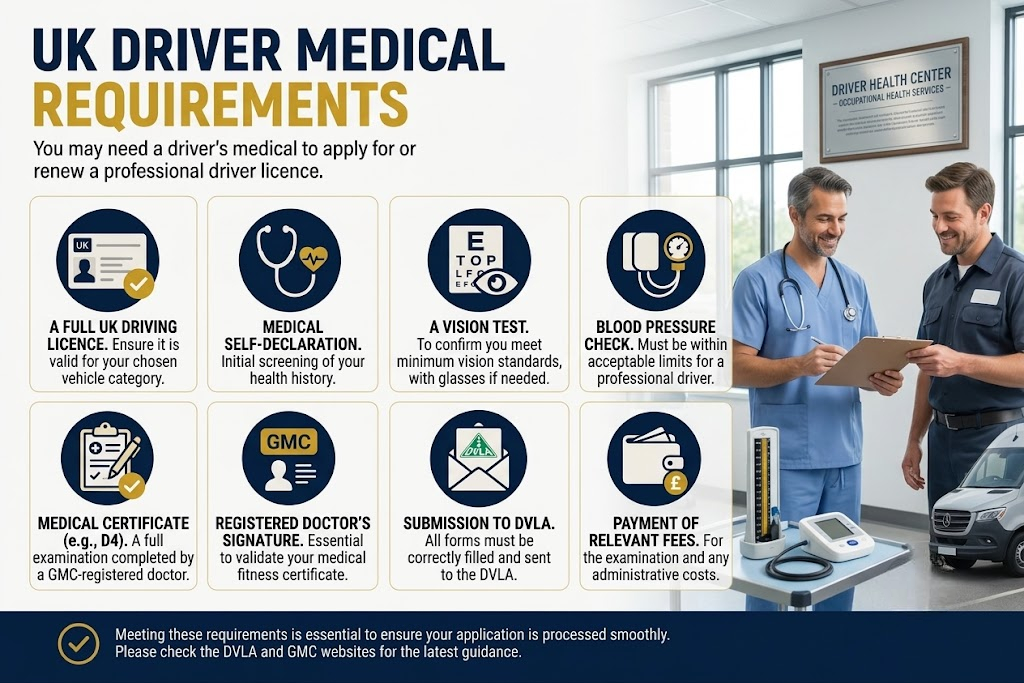
Preparing for your appointment helps the assessment run smoothly. You should normally bring:
- Valid photo identification.
- Your driving licence.
- Glasses or contact lenses, if worn.
- A list of current medications.
- Details of any significant medical conditions.
- Relevant hospital letters, if requested.
- Your DVLA D4 form for HGV or other Group 2 applications.
- Any paperwork requested by the licensing authority.
Driver Medical Cost
One of the most common questions drivers ask is about driver medical costs. There is no fixed national price because fees vary between providers.
Factors that influence the cost include:
- The type of medical care required.
- The provider you choose.
- Your location.
- Whether additional vision testing is needed.
- Whether further medical information is required.
Although cost matters, choosing an experienced provider is equally important. A thorough assessment completed correctly helps avoid unnecessary delays with your licence application.
How to Prepare for a Driver Medical
A little preparation can make your appointment quicker and less stressful.
Before attending your assessment:
- Get a good night’s sleep.
- Stay well hydrated.
- Wear your usual glasses or contact lenses.
- Bring all requested documents.
- Prepare a list of medications.
- Be ready to discuss your medical history honestly.
- Allow enough time to arrive without rushing.
If you have recently undergone hospital treatment or specialist care, bring any relevant letters if requested.
Common Medical Conditions That May Affect Driving

Many medical conditions need to be considered before you can be deemed safe to drive by a DVLA driver medical assessor. In most cases, it is, but there are exceptions. It is possible to continue driving, albeit with some additional medical checks and restrictions.
Diabetes
Diabetics can drive, assuming their condition is well-managed. They should be under the supervision of their doctor.
The DVLA driver medical will need to know about your medication and glucose levels and whether you get episodes of hypoglycaemia (Low Sugar levels).
High Blood Pressure
High blood pressure in itself is not a reason to stop driving. If your pressure is extremely high, you may need to be under treatment or be referred to a specialist before you can resume driving.
Epilepsy
You can continue to drive depending on several factors. You will need to pass a medical examination, and it will be necessary to report any changes in your condition to the DVLA.
Sleep Apnoea
If you have sleep apnoea, you should be aware that there is an increased risk of accidents if you are tired. If your sleep apnoea is being successfully treated, you should be fit to drive.
Heart Conditions
If you have had a heart attack, an irregular heartbeat, or another condition affecting your heart. You may need to stop driving for a period of time or be subject to further medical tests.
Vision
Good eyesight is a must for drivers, and you must be able to meet the eyesight requirements for driving. You must use any corrections if necessary.
Finding a Driver Medical Near You
If you are searching for a driver’s medical near me, look for a clinic that offers tests for your specific licence type.
Many providers offer dedicated appointments for:
- HGV medicals.
- D4 medicals.
- Taxi medicals.
- PCV medicals.
- Occupational driver assessments.
- DVLA medical examinations.
Choose a clinic with GMC-registered doctors to ensure professional driver medicals and accurate documentation. Driver Medical Test has multiple clinics across the UK. They provide reliable medical services at convenient locations.
Frequently Asked Question
1: Can I book a driver's medical without seeing my own GP?
A: Yes. Many independent clinics provide driver medical examinations carried out by GMC-registered doctors. In many cases, you do not need to see your own GP unless additional medical information is specifically required.
2: How often do I need a driver's medical?
A: The DVLA or your local authority is the best place to check for any general guidance on how often you are required to take one based on the type of licence. As well as whether any of the categories listed, such as an HGV, PCV, and Taxi Licence, require medicals for renewal or on medical grounds.
3: What should I wear to a driver's medical appointment?
A: There are no requirements related to dress, but it is recommended to wear comfortable clothes. Loose clothing will help to check your blood pressure and perform any other physical tests that might be required during the examination.
4: What happens if my blood pressure is too high during a driver's medical?
A: If your blood pressure reading is higher than the required level, the doctor may decide to take another reading after some time has lapsed.
5: Can I reschedule my driver medical appointment?
A: Yes, most of the time, as long as you give them enough notice. The sooner you let them know, the sooner they can get you scheduled.
6: What if I forget to bring any necessary documents?
A: If you forget to bring any documents that are necessary for your medical, they may have to reschedule your appointment. Be sure to bring any documents you need for your medical so that your appointment goes smoothly.
Conclusion

A driver’s medical helps ensure you meet the health standards needed to drive safely. Whether you need an HGV medical, taxi medical, or occupational assessment. Selecting an experienced and professional medical services provider is an easy task.
If you have a medical condition, it doesn’t necessarily mean that you can’t drive your vehicle. Your particular medical condition will be taken into consideration.
Book your driver medical test today and take the next step towards obtaining or renewing your driving licence with confidence.
